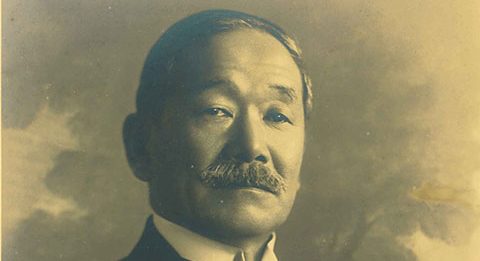
The Contribution of Judo to Education
The object of this lecture is to explain to you in a general way what Judo is. In our feudal times, there were many military exercises such as fencing, archery, the use of spears, etc. Among them there was one called Jujutsu which was a composite exercise, consisting principally of the ways of fighting without weapons; using, however, occasionally daggers, swords and other weapons.
The kinds of attack were chiefly throwing, hitting, choking, holding the opponent down and bending or twisting the opponent’s arms or legs in such a way as to cause pain or fracture. The use of swords and daggers was also taught. We had also multitudinous ways of defending ourselves against such attacks. Such exercise, in its primitive form, existed even in our mythological age. But systematic instruction, as an art, dates only from about three hundred fifty years ago.
In my younger days I studied this art with three eminent masters of the time. The great benefit I derived from the study of it led me to make up my mind to go on with the subject more seriously, and in 1882 I started a school of my own and called it Kodokan. Kodokan literally means a school for studying the way, the meaning of the way being the concept of life itself. I named the subject I teach Judo instead of Jujutsu. In the first place I will explain to you the meaning of these words. Ju means gentle or to give way, Jutsu, an art or practice, and Do, way or principle, so that Jujutsu means an art or practice of gentleness or of giving way in order to ultimately gain the victory; while Judo means the way or principle of the same.
Can this principle be applied to other fields of human activity?
Yes, the same principle can be applied to the improvement of the human body, making it strong, healthy and useful, and so constitutes physical education. It can also be applied to the improvement of intellectual and moral power, and in this way constitutes mental and moral education. It can at the same time be applied to the improvement of diet, clothing, housing, social intercourse, and methods of business, thus constituting the study and training in living.
I gave this all-pervading principle the name of “Judo”. So Judo, in its fuller sense, is a study and method in training of mind and body as in the regulation of life and affairs.
This method of physical education in attack and defense form, I shall show you by actual practice. This is divided into two kinds of exercises: one is individual exercise and the other is exercise with an opponent (as demonstrated).
From what I have explained and shown by practice, you have no doubt understood what I mean by physical education based on the principle of maximum efficiency.
Although I strongly advocate that the physical education of a whole nation should be conducted on that principle, at the same time I do not mean to lay little emphasis on athletics and various kinds of martial exercise. Although they cannot be deemed appropriate as a physical education of a whole nation, yet as a culture or a group or groups of persons, they have their special value and I by no means wish to discourage them, especially Randori in Judo.
One great value of Randori lies in the abundance of movements it affords for physical development. Another value is that every movement has some purpose and is executed with spirit, while in ordinary gymnastics exercises movements lack interest. The object of a systematic physical training in Judo is not only to develop the body but to enable a man or a woman to have a perfect control over mind and body and make him or her ready to meet any emergency whether that be a pure accident or an attack by others.
Although exercise in Judo is generally conducted between two persons, both in Kata and in Randori, and in a room specially prepared for the purpose, yet that is not always necessary. It can be practiced by a group or by a single person, on the playground, or in an ordinary room. People imagine that falling in Randori is attended with pain and sometimes with danger. But a brief explanation of the way one is taught to fall will enable them to understand that there is no such pain or danger.
I shall now proceed to speak of the intellectual phase of Judo. Mental training in Judo can be done by Kata as well as by competition between two persons, using all the resources at their command and obeying the prescribed rules of Judo, both parties must always be wide awake, and be endeavoring to find out weak points of the opponent, being ready to attack whenever opportunity allows. Such an attitude of mind in devising means of attack tends to make the pupil earnest, sincere, thoughtful, cautious and deliberate in all his dealings. At the same time one is trained for quick decision and prompt action, because in Randori unless one decides quickly and acts promptly he will always lose his opportunity either in attacking or in defending.
Again, in Randori each contestant cannot tell what his opponent is going to do, so each must be prepared to meet any sudden attack by the other. Habituated to this kind of mental attitude, he develops a high degree of mental composure, or “poise.” Exercise of the power of attention and observation in the gymnasium or place of training, naturally develops such power, which is so useful in daily life.judoinfo.com
Judo is a study and training in mind and body as well as in the regulation of one’s life and affairs. From the thorough study of the different methods of attack and defense I became convinced that they all depend on the application of one all-pervading principle, namely: “Whatever be the object, it can best be attained by the highest or maximum efficient use of mind and body for that purpose”.
This principle of maximum efficiency I named Seiryoku-Zenyo. That is to say, to make the best use of one’s mental and physical energy. In the case of attack and defense, to make the best use of one’s energy may be taken to mean to gain victory over an opponent by the best use of one’s energy, and in the case of the body, to make the best use of one’s energy may be taken to mean to develop the body in the best way. In the case of the mind, to make the best use of one’s energy may be taken to mean to cultivate the mind in the best way. And in the case of the regulation of life and affairs, to make the best use of one’s energy may be taken to mean to make the best use of one’s energy in the conduct of life and affairs.
Therefore, in order to make the best use of one’s energy, one must, in the first place, be trained to be able to make the best use of one’s energy. In the second place, one must be trained to be able to make the best use of one’s energy in the best way. In the third place, one must be trained to be able to make the best use of one’s energy in the best way in the best manner. In the fourth place, one must be trained to be able to make the best use of one’s energy in the best way in the best manner in the best direction.
Therefore, Judo, in its fuller sense, is a study and method in training of mind and body as in the regulation of life and affairs.
Bibliographic Reference:
- Kano, Jigoro. “The Contribution of Judo to Education.” Journal of Health and Physical Education, vol. 3, 1932, pp. 37–40, 58.