Junomichi Scotland Seminar – October 2025
Irimi: Entering with the Whole Being

The weekend of Saturday 4 and Sunday 5 October marked a significant moment for Junomichi Scotland.
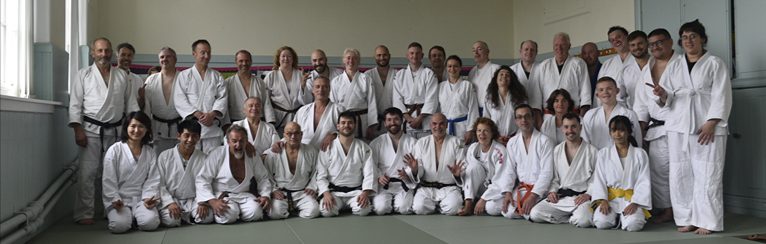
Under the guidance of Rudolf Di Stefano, member of the Technical Commission of the Fédération Indépendante et Autonome de Junomichi (FIAJ), thirty-seven practitioners gathered for two days of sincere and concentrated study at the Gilmerton Community Centre.
Our warm thanks go to the Centre and its staff for their generous hospitality, which created the calm, welcoming atmosphere necessary for such depth of work.
A Gathering of Study and Presence
The seminar unfolded in an atmosphere of attention and openness.
Practitioners of all levels shared the tatami in a collective exploration of movement, sensitivity, and understanding.
Each exercise and each exchange were approached with simplicity and sincerity, qualities that lie at the heart of Junomichi practice.
Beyond the study of this principle through the body and feeling, the seminar offered moments of dialogue, silence, and reflection, reminding everyone that Junomichi is not a performance, but a living search for balance, within oneself and with others.
Irimi — The Art of Making Space
The central theme, Irimi, was explored throughout both days.
Often translated as “entering”, Irimi in Junomichi is far more than an external motion.
It is the art of making space within ourselves, of resolving inner oppositions, so that we can move freely toward the other without tension or conflict.
Before any encounter, the body must first find openness, a state where presence replaces defence, and control becomes awareness rather than domination.
When this inner space becomes clear, movement no longer belongs to one or the other, it becomes a shared rhythm.
To enter in this sense is to meet, not to confront, but to receive and respond in harmony.
Irimi is sometimes described as “the body that enters”.
There is always an inside and an outside, yet in true Irimi these two no longer oppose one another.
They remain distinct but connected, the difference is preserved without creating division.
In that quiet relationship between the two, real movement, and real encounter, can arise.
Under Rudolf’s guidance, participants discovered that such entering begins in stillness, and that true Irimi emerges when there is no longer separation, only one continuous flow of attention.
The Spirit of Dr Jigoro Kano
At the heart of this study lies the vision of Dr Jigoro Kano, the founder of Judo, who taught that practice must lead to both self-development and mutual benefit.
Kano’s two guiding maxims, Seiryoku Zenyo (maximum efficiency through minimum effort) and Jita Kyoei (mutual aid and mutual prosperity), remain the foundation of all true practice.
In Junomichi, or True Judo, these are not moral slogans or distant ideals.
They are living studies, tested through direct experience.
Mutual prosperity is not an abstract notion but a concrete search within every encounter, an act of cooperation where both can grow.
The seminar was guided by this same spirit, to explore Irimi not as an idea, but as a real and tangible way of embodying these maxims through body, sensation, and relation.
Thus, in Junomichi, the maxims of Dr Kano and the five principles clarified by Igor Correa — Decision, Control, Mobility, Non-Opposition, and Encompassing — are not words to recite but directions to be lived.
Each is a field of research where movement, awareness, and ethics become one and the same gesture.
Randori — The Joy of Encounter
The seminar culminated in moments of randori, allowing everyone to meet and work with each partner.
These exchanges revealed the richness of diversity, different bodies, energies, and tempos, yet all guided by the same intention, to learn through contact, not competition.
Randori, approached in this way, becomes a conversation.
Each encounter invites us to listen, adapt, and understand ourselves through the presence of another.
The result is not victory or defeat, but a deeper sense of unity and movement shared.
Gratitude and Continuation
Over the course of the weekend, a spirit of friendship, focus, and discovery filled the tatami.
Moments of laughter balanced moments of silence, intensity alternated with calm.
Each participant contributed to the living research that defines Junomichi, a study where technique and philosophy meet through direct experience.
Our heartfelt gratitude goes to Rudolf Di Stefano for his clarity of teaching, to the Gilmerton Community Centre for their kind support, and to all practitioners for their sincerity and dedication.
Your collective presence made this seminar a true expression of the Way of Giving way, the living path of Dr Jigoro Kano’s original Judo.