Junomichi is an educational system

Junomichi, (real Judo), is an educational tool in a sense that is rarely understood in modern contexts.
When education is mentioned, it is commonly associated with academic subjects such as mathematics, literature, or the arts. These disciplines develop important capacities, yet they do not necessarily address a more fundamental question: how does one learn to become a human being in a complete and responsible way?
Jigoro Kano approached this question directly.
When he created Judo, his intention was not to establish a sport. This is the deviation taken in the 50s. His purpose was to to build an educational system.
The aim was the development of the individual through the body and mind, leading to a meaningful contribution to society.
In this perspective, practice is not an end in itself. It is a means through which a person learns how to exist, act, and relate.
A central aspect of this approach is the question of self-awareness.
Becoming a better human is based on the capacity to perceive oneself clearly. This includes recognising one’s own selfishness. Kano considered that without awareness of one’s own tendencies, there can be no genuine awareness of others or of society. The relationship to the world begins with the relationship to oneself.
This leads to a simple but demanding implication: one must first learn to appreciate oneself before being able to appreciate others. This is practical statement. If a person is disconnected from themselves, their actions towards others remain superficial or inconsistent.
Within this framework, several capacities are progressively developed.
The practitioner learns to decide without hesitation or second thought. They learn to remain mobile in changing situations, rather than becoming fixed or resistant. They learn to maintain control of themselves, regardless of external conditions. They learn not to oppose themselves to the environment, but to work with it. They learn to commit fully to their actions.
These qualities are developed and experienced physically, in real time, through interaction with others. The partner is a necessary condition for learning. Through this relationship, each person contributes to the development of the other.
The partner represents society, or more simply, another human being.
In everyday life, we constantly interact with others, and over time we build narratives that deeply influence, at a biological level, both mind and body. The partner becomes a mirror of what we are.
Jigoro Kano understood this early on. This is why Ju no Kata was taught to beginners. They were invited to relearn slowness, allowing a deeper incorporation of what they are. There is no projection, but rather an appreciation of oneself through the presence of the other.
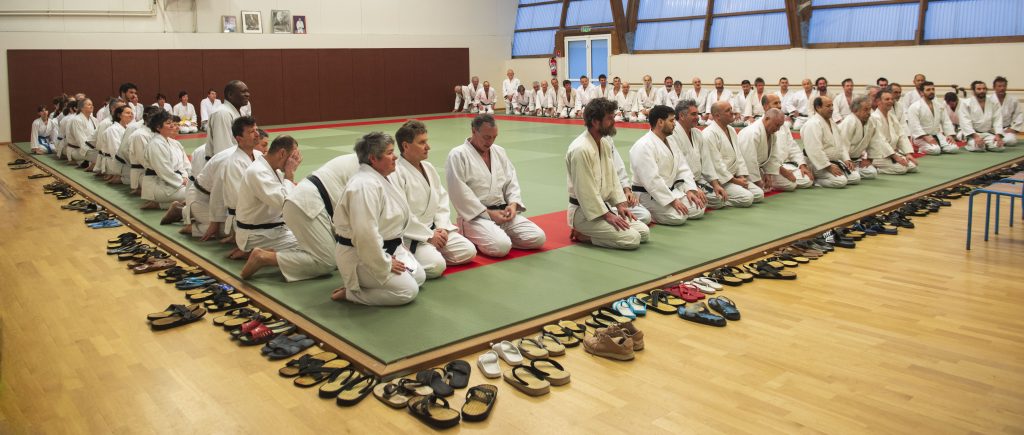
This also leads to a collective dimension of education. The responsibility for learning does not rest solely on a teacher. Practitioners learn from one another, regardless of level. A beginner brings a form of sincerity and unpredictability that challenges more experienced practitioners. In return, experienced practitioners refine their understanding by engaging with less experienced ones. Knowledge circulates, rather than being held.
Such an approach requires a specific environment. It cannot be reduced to a set of techniques or exercises. It is a system in which the individual transforms through the combined action of body, perception, and relationship.
In this sense, Junomichi continues the educational vision of Kano. It is not a return to a historical form, but the continuation of an intention: to create conditions in which individuals can develop themselves in a complete way, and through that development, participate more accurately and responsibly in society.
Education, in this perspective, is not limited to what one knows. It is defined by how one exists, how one acts, and how one relates. Junomichi offers a framework in which this form of education can take place.